Friday, February 21, 2014

Prayers for Ukraine

             
(Independence Square Under Protest in Kiev      Picture:  EPA Igor Kovalenko  )

 
         Unlike most American boys of his age, Daniel knew a fair bit about Ukraine, and even knew that it is no longer "The Ukraine" but now, simply "Ukraine".    Homeschooling gave us the benefit of being able to study some history and geography depth that would not normally be included in the contemporary public school curriculum, and so, he knew a great deal more about the world, and about other nations than most Americans do.   He also knew something about Ukraine for another reason.  My husband's family were originally from Switzerland in the 1630s.  One of his ancestors was a mayor who got into trouble with the powerful Catholic church of the day, when he stated that he believed that a baptism should be done on someone who was aware of the choice they were making, rather than have a religious baptism performed upon them as an infant.  In that day, this was heresy, and as a result, he and his his large family had to flee for their lives, and  went to Germany.  Eventually, when Catherine the Great gave forty acres or more to families willing  to settle in what became the Ukraine, my husband's ancestors lived there.    (Those who are interested in reading more about this can look up the Molotschna Mennonite Settlement in Zaporizhia Oblast, Ukraine )  My husband's ancestors eventually came to the United States when it became clear to them that the Mennonites were to be controlled by the government there.  Daniel knew our family history on both sides, and I think that knowledge of family history made world history much more relatable and therefore more interesting to him.

                   It has been interesting to me that although I have never mentioned our family's history in Ukraine, however transitory, that Ukraine has been one of the nations that reads this blog and my others, in the highest numbers.  I really hope that some of the things we discuss here is somehow inspiring or encouraging, especially to those is Ukraine presently.

                   These are very difficult times in Ukraine.  Although American mainstream television is quite insular and only reports on things that appear to be at the pleasure of our own present regime, we have learned about the present challenges from foreign news networks, such as France 24, NHK from Japan, DW from Germany, RT from Russia and of course, BBC from the United Kingdom.   There has been turmoil in Ukraine in past years.  Economist and educator Yulia Tymoshenko had been Ukraine's first female prime minister.  Although she had  been a prominent politician there, and has been jailed on what appeared to most of the world to be trumped up charges. She was pro Ukrainian integration into the European Union whereas her opposition would prefer alliances only with the Russian Federation.  This has left a number of Ukrainians feeling underrepresented and concerned.  Many of them wish to join the European Union rather than preserving an alliance with Russia that they feel has historically been their oppressor.

                       The present prime minister is Viktor Yanukovych. Mr. Yanukovych had promised to reduce the powers held by the prime minister and to leave more to the Constitution, however these changes have not come as quickly as most Ukrainians have wished.  There is also the perception that he may be a Russian puppet. Many Ukrainians believe he is guilty of corruption and of cronyism. Many Ukrainians are demanding that he step down.    There have been numerous violent protests and Ukrainian police and military have killed protestors and sometimes simply students who were in the wrong place at the wrong time.  As I write this post, many Ukrainians believe that Ukraine sits on the verge of civil war.  Just a few hours ago, Mr. Yanukovych agreed to an early election.


                 For more than a year Ukraine has been on the verge of civil war.   Uncertainty and fear rule the day, and trust in the authorities is very weak.  I am reminded of trends which seem to be occurring here albeit a little more slowly, as well.  Please pray for the people of Ukraine who simply wish to live peacefully with equitable management. Please pray for the safety of the people of Ukraine.  We are thinking of you and your families.


This link explains some of the recent turmoil in Ukraine and their current regime's role in this:

 http://www.salon.com/2014/02/21/how_to_make_sense_of_the_violence_in_ukraine_partner/


Update:   February 22, 2014         It hasn't happened just yet but Parliament in Ukraine has voted to release Yulia Tymoshenko, who is currently in the hospital for a back ailment.    Parliament has promised to return to the Constitution as written in 2004.   However, the bulk of the people in Ukraine still wish to see Viktor Yanukovych removed.   These remain difficult times there.  Many people are concerned that such concessions may not be permanent ones.  They do not trust their present government.


Saturday, February 15, 2014

Happy Valentine's Day 2014

        
We have horses in chocolate colors and here we have horses made of chocolate.


           After the passing of a child, even five years down the road, holidays can be difficult and they can be added to a stack of holidays that just simply didn't live up to the ones you thought you could anticipate, had that child been alive.  The day is not only not what you had intended for yourself, but not what you had anticipated for your child.  This would be a Valentine's Day in which Daniel would have been 17 and only three months from his eighteenth birthday.  This might have been a special date night for him.
         
 Unfortunately, this is not the timeline we have on our own trip to Earth.  In this timeline we have time remaining for the rest of us here on Earth without him, and so we are faced with the challenge of making this time count and be meaningful, not only to those of us in the family who remain, but to Daniel also.
       
   This years Valentine's Day post will appear on another one of my blogs located at the link below.

 I hope that you too with find some joy and some meaning from it. I think Daniel would approve of the manner in which we spent our time today.


               Chocolate Horses


Happy Valentine's Day


"The Only Name (Yours Will Be)"          by Big Daddy Weave


Thursday, January 23, 2014

Messages from Daniel


  I can go quite a time now without seeing Daniel or hearing about him in a dream.    Last night however, I heard from him twice.    In the first dream, some time before three am, I dreamt that my husband and I were busily running an errand.    My husband told me in the dream, that Daniel would be out the rest of the afternoon.  He was out with his new friend and they were practicing target shooting with their new rifles.  In the dream I was disappointed, because I had hoped to see him and spend time with him when we got home that day.

                      Of course, I woke up and I don't have the option of completing an important errand and seeing Daniel here at the house afterward.

                       Later, I fell back to sleep and this time I saw Daniel.   He was as happy and as animated as I remember.   "Grandma (my husband's mother) said that I should stop by and see you." he said.     "Thank you, sweetheart.  You know how much I love you", I said.    "How are you ?"    I asked.    Then, he began to tell me of all the magical things he was learning and of all the people he was meeting.   He spoke faster than my brain could process, and I am afraid I didn't retain much.  I did get the idea that he is safe and well.

                    I have come to believe that although some of these types of dreams come from my own brain, creating a safe place where I can remember our beloved Daniel, but that these " sightings in dreams" don't all originate this way.   I have had dreams in which I have received information from Daniel and from my Dad, which turned out to be factually accurate later.

                  So, I believe that Daniel visited last night, just to let me know that he is fine, and is thriving.  He knows we love to hear from him.  Perhaps this is God's way of making our remaining time on Earth tolerable without Daniel, especially when life in the US right now, is so uncertain and scary.

                  If you have a loved one who has gone on ahead of you, perhaps you can hear from them also by being open to hearing from them in dreams.   I hear from Daniel and my Dad and others usually between 3 and 4 am, but sometimes as late as 5 am.   I certainly appreciate the encouragement !


Music                  Sarah Slean                      "Notes from the Underground"


Saturday, January 18, 2014

Is This What Happened to Daniel ?


These are pictures of Daniel at seven and eight.

 
                Because Daniel was well and had no known cardiac issues, conduction or otherwise, no baseline EKG was ever obtained in his twelve and a half years on Earth.   And so, when he experienced a sudden death with no reasons found on multiple autopsies afterward, the medical examiners assigned a presumptive cause of death. A baseline EKG could not be used to determine whether there were signs of bundle branch block, atrial fibrillation, or a "J-wave".    Based on our family history of elderly members having conduction disorders, and the character of Daniel's sudden death, and inability to respond to immediate CPR, the cause of death is surmised to be a cardiac conduction disorder which evolved into a ventricular arrhythmia which was incompatible with life.  There are a number of types of conduction disorders which can impact babies, children, teens and young adults.   Today, Medscape sent me additional medical continuing education for my RN license.   Although Brugada Syndrome does have some commonalities with Daniel's case, there are also great differences.
     Normally, when I write an informational or educational post on this blog, I paraphrase the information on the most recent studies in order to be more readily understood by the general public.  In this case however, I thought this latest article written by cardiologists was so important, that I should include it verbatim, crediting both Medscape and the Authors, Jose M. Dizon, MD, and Jeffrey N. Rottman, MD.    If you or your family have anyone who experienced a sudden cardiac death, then the article which follows should probably be printed out and taken to your physician, so that other family members can be screened and potentially treated to avoid the potential for sudden arrhythmiccardiac death.
     If this post saves even one life, then the article, and this post will have done its job.
                                                           _________________________

Brugada Syndrome 

Author: Jose M Dizon, MD; Chief Editor: Jeffrey N Rottman, MD 

Practice Essentials

Brugada syndrome is a disorder characterized by sudden death associated with one of several ECG patterns characterized by incomplete right bundle-branch block and ST-segment elevations in the anterior precordial leads.

Essential update: Predicting prognosis in Brugada syndrome with J-wave characteristics

In patients with Brugada syndrome, the presence of a J wave in multiple leads and horizontal ST-segment morphology after J wave are associated with a higher incidence of cardiac events, according to a recent study of 460 patients with Brugada syndrome.[1] Important predictors of cardiac events included symptoms, QRS duration in lead V2 longer than 90 ms, and inferolateral J wave and/or horizontal ST-segment morphology after J wave.[1] 

Signs and symptoms

Signs and symptoms in patients with Brugada syndrome may include the following:
  • Syncope and cardiac arrest: Most common clinical manifestations; in many cases, cardiac arrest occurs during sleep or rest
  • Nightmares or thrashing at night
  • Asymptomatic, but routine ECG shows ST-segment elevation in leads V1-V3
  • Associated atrial fibrillation (20%)[2]
  • Fever: Often reported to trigger or exacerbate clinical manifestations
The lack of a prodrome has been reported to be more common in patients with ventricular fibrillation documented as the cause of syncope in patients with Brugada syndrome.[3]
See Clinical Presentation for more detail.


Diagnosis

Most patients with Brugada syndrome have a normal physical examination. However, such an examination is necessary to exclude other potential cardiac causes of syncope or cardiac arrest in an otherwise healthy patient (eg, heart murmurs from hypertrophic cardiomyopathy or from a valvular or septal defect).
Testing
In patients with suspected Brugada syndrome, consider the following studies:
  • 12-lead ECG in all patients with syncope
  • Drug challenge with a sodium channel blocker in patients with syncope without an obvious cause
  • Electrophysiologic study to determine the inducibility of arrhythmias for risk stratification
Laboratory tests that may aid in the diagnosis of Brugada syndrome include the following:
  • Serum potassium and calcium levels: In patients presenting with ST-segment elevation in the right precordial leads
  • Potassium and calcium levels: ECG patterns in patients with hypercalcemia and hyperkalemia similar to that of Brugada syndrome
  • CK-MB and troponin levels: In patients with symptoms compatible with an acute coronary syndrome
  • Genetic testing for a mutation in SCN5A
Further testing may be indicated to exclude other diagnostic possibilities.
Imaging studies
Perform echocardiography and/or MRI, primarily to exclude arrhythmogenic right ventricular cardiomyopathy, as well as to assess for other potential causes of arrhythmias.
See Workup for more detail.

Management

To date, the only treatment that has proven effective in treating ventricular tachycardia and fibrillation and preventing sudden death in patients with Brugada syndrome is implantation of an automatic implantable cardiac defibrillator (ICD).
No pharmacologic therapy has been proven to reduce the occurrence of ventricular arrhythmias or sudden death; however, theoretically, drugs that counteract the ionic current imbalance in Brugada syndrome could be used to treat it. For example, quinidine, which blocks the calcium-independent transient outward potassium current (Ito), has been shown to normalize the ECG pattern in patients with Brugada syndrome.[4] However, quinidine also blocks sodium (Na) currents, which could have contrary effects.
See Treatment and Medication for more detail.

Image library

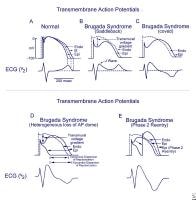
Schematics show the 3 types of action potentials iSchematics show the 3 types of action potentials in the right ventricle: endocardial (End), mid myocardial (M), and epicardial (Epi). A, Normal situation on V2 ECG generated by transmural voltage gradients during the depolarization and repolarization phases of the action potential. B-E, Different alterations of the epicardial action potential that produce the ECG changes observed in patients with Brugada syndrome. Adapted from Antzelevitch, 2005. 
                          

Background

Brugada syndrome is a disorder characterized by sudden death associated with one of several electrocardiographic (ECG) patterns characterized by incomplete right bundle-branch block and ST elevations in the anterior precordial leads. See the image below.
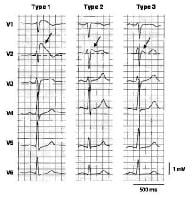
Three types of ST-segment elevation in Brugada synThree types of ST-segment elevation in Brugada syndrome, as shown in the precordial leads on ECG in the same patient at different times. Left panel shows a type 1 ECG pattern with pronounced elevation of the J point (arrow), a coved-type ST segment, and an inverted T wave in V1 and V2. The middle panel illustrates a type 2 pattern with a saddleback ST-segment elevated by >1 mm. The right panel shows a type 3 pattern in which the ST segment is elevated < 1 mm. According to a consensus report (Antzelevitch, 2005), the type 1 ECG pattern is diagnostic of Brugada syndrome. Modified from Wilde, 2002. In the initial description of Brugada syndrome, the heart was reported to be structurally normal, but this concept has been challenged.[5] Subtle structural abnormalities in the right ventricular outflow tract have been reported.
Brugada syndrome is genetically determined and has an autosomal dominant pattern of transmission in about 50% of familial cases (see Etiology). The typical patient with Brugada syndrome is young, male, and otherwise healthy, with normal general medical and cardiovascular physical examinations.
Patients with Brugada syndrome are prone to develop ventricular tachyarrhythmias that may lead to syncope, cardiac arrest, or sudden cardiac death.[6, 7, 8] Infrahisian conduction delay and atrial fibrillation may also be manifestations of the syndrome.[9, 10]
About 5% of survivors of cardiac arrest have no clinically identified cardiac abnormality. About half of these cases are thought to be due to Brugada syndrome.[11]
At present, implantation of an automatic implantable cardiac defibrillator (ICD) is the only treatment proven effective in treating ventricular tachycardia and fibrillation and preventing sudden death in patients with Brugada syndrome (see Treatment).


Pathophysiology

Brugada syndrome is an example of a channelopathy, a disease caused by an alteration in the transmembrane ion currents that together constitute the cardiac action potential. Specifically, in 10-30% of cases, mutations in the SCN5A gene, which encodes the cardiac voltage-gated sodium channel Nav 1.5, have been found. These loss-of-function mutations reduce the sodium current (INa) available during the phases 0 (upstroke) and 1 (early repolarization) of the cardiac action potential.
This decrease in INa is thought to affect the right ventricular endocardium differently from the epicardium. Thus, it underlies both the Brugada ECG pattern and the clinical manifestations of the Brugada syndrome.
The exact mechanisms underlying the ECG alterations and arrhythmogenesis in Brugada syndrome are disputed.[12] The repolarization-defect theory is based on the fact that right ventricular epicardial cells display a more prominent notch in the action potential than endocardial cells. This is thought to be due to an increased contribution of the transient outward current (Ito) to the action potential waveform in that tissue.
A decrease in INa accentuates this difference, causing a voltage gradient during repolarization and the characteristic ST elevations on ECG. Research has provided human evidence for a repolarization gradient in patients with Brugada syndrome using simultaneous endocardial and epicardial unipolar recordings.[13] See the image below.
Schematics show the 3 types of action potentials iSchematics show the 3 types of action potentials in the right ventricle: endocardial (End), mid myocardial (M), and epicardial (Epi). A, Normal situation on V2 ECG generated by transmural voltage gradients during the depolarization and repolarization phases of the action potential. B-E, Different alterations of the epicardial action potential that produce the ECG changes observed in patients with Brugada syndrome. Adapted from Antzelevitch, 2005. When the usual relative durations of repolarization are not altered, the T wave remains upright, causing a saddleback ECG pattern (type 2 or 3). When the alteration in repolarization is sufficient to cause a reversal of the normal gradient of repolarization, the T wave inverts, and the coved (type 1) ECG pattern is seen. In a similar way, a heterogeneous alteration in cardiac repolarization may predispose to the development of reentrant arrhythmias, termed phase 2 reentry, that can clinically cause ventricular tachycardia and ventricular fibrillation.[14]
An alternative hypothesis, the depolarization/conduction disorder model, proposes that the typical Brugada ECG findings can be explained by slow conduction and activation delays in the right ventricle (in particular in the right ventricular outflow tract).[12]
One study used ajmaline provocation to elicit a type 1 Brugada ECG pattern in 91 patients, and found that the repolarization abnormalities were concordant with the depolarization abnormalities and appeared to be secondary to the depolarization changes.[15] Using vectorcardiograms and body surface potential maps, investigators were able to show that depolarization abnormalities and conduction delay mapped to the right ventricle.


Etiology

The prototypical case of Brugada syndrome has been associated with alterations in the SCN5A gene, of which nearly 300 mutations have been described.[16] Mutations in other genes have been proposed to cause a variant of Brugada syndrome, including the genes coding for alpha1- and beta2b-subunits of the L-type calcium channel (CACNA1C and CACNB2), which are thought to cause a syndrome of precordial ST elevation, sudden death, and short QT interval.[17]
Mutations in the genes GPD1-L[18] and SCN1B[19] have been identified in a few familial cases. Cases in which a mutation in the SCN5A gene cannot be demonstrated may be due to mutations of these genes, due to other unidentified genes, or located in regions of the coding sequence or promoter region of SCN5A that are not routinely sequenced in lab tests.
Many clinical situations have been reported to unmask or exacerbate the ECG pattern of Brugada syndrome. Examples are a febrile state, hyperkalemia, hypokalemia, hypercalcemia, alcohol or cocaine intoxication, and the use of certain medications, including sodium channel blockers, vagotonic agents, alpha-adrenergic agonists, beta-adrenergic blockers, heterocyclic antidepressants, and a combination of glucose and insulin.[14] 


Epidemiology

United States statistics

Because of its recent identification, the prevalence of Brugada syndrome is not well established. In a large university hospital on the West Coast of the United States, the prevalence of a Brugada ECG pattern among unselected, mainly white and Hispanic adults was 2 of 1348 patients (0.14%); in both cases, the ECG patterns were type 2.[20] The prevalence in Asian and other ethnic populations may be higher.

International statistics

In parts of Asia (eg, the Philippines, Thailand, Japan), Brugada syndrome seems to be the most common cause of natural death in men younger than 50 years. It is known as Lai Tai (Thailand), Bangungot (Philippines), and Pokkuri (Japan). In Northeast Thailand, the mortality rate from Lai Tai is approximately 30 cases per 100,000 population per year.[21]

Race-, sex-, and age-related demographics

Brugada syndrome is most common in people from Asia. The reason for this observation is not yet fully understood but may be due to an Asian-specific sequence in the promoter region of SCN5A.[22]
Brugada syndrome is 8-10 times more prevalent in men than in women, although the probability of having a mutated gene does not differ by sex. The penetrance of the mutation therefore appears to be much higher in men than in women.
Brugada syndrome most commonly affects otherwise healthy men aged 30-50 years, but affected patients aged 0-84 years have been reported. The mean age of patients who die suddenly is 41 years.[14]


Prognosis

Brugada syndrome is a cause of polymorphic ventricular tachycardia, which may degenerate into ventricular fibrillation and cause cardiac arrest. Prolonged hypoxia during cardiac arrest may leave patients with neurologic sequelae. Implantable cardioverters-defibrillators (ICDs) are often used to treat patients with Brugada syndrome, exposing them to complications related to device implantation and the potential for inappropriate shocks.
During a mean follow-up of 24 months, sudden cardiac death or ventricular fibrillation occurred in 8.2% of patients with Brugada syndrome. A history of syncope, a spontaneously abnormal ECG, and inducibility during programmed electrical stimulation (by one study) significantly increased this risk.[7]
Brugada syndrome may be a significant cause of death, aside from accidents, in men under 40. The true incidence is not known due to reporting biases. Although there is a strong population dependence, an estimated 4% of all sudden deaths and at least 20% of sudden deaths in patients with structurally normal hearts are due to the syndrome. Those with the syndrome have a mean age of sudden death of 41 ±15 years.[23] 


Patient Education

Educating the patient and his or her family members and coworkers about basic cardiopulmonary resuscitation (CPR) is important. Genetic counseling is reasonable if desired by the patient and family

History

Syncope and cardiac arrest are the most common clinical manifestations leading to the diagnosis of Brugada syndrome. Nightmares or thrashing at night may occur. However, some patients remain asymptomatic, and the diagnosis of Brugada syndrome is suggested by a routine ECG showing ST-segment elevation in leads V1 through V3.
A family history of sudden cardiac death is common, though not universal, as the syndrome can occur sporadically. In about 20% of patients, atrial fibrillation is an associated arrhythmia.[2]
The context of the cardiac event is important. In many cases, cardiac arrest occurs during sleep or rest. Cases occurring during physical activity are rare. Fever is often reported to trigger or exacerbate the clinical manifestations of Brugada syndrome.
A 2012 study suggests that the quality of symptoms prior to syncope can predict a benign or malignant cause in patients with Brugada syndrome. Specifically, the lack of a prodrome was more common in patients with ventricular fibrillation documented as the cause of syncope.[3]

Physical Examination

The physical examination is usually normal in patients with Brugada syndrome. Nevertheless, physical examination is required to rule out other possible cardiac causes of syncope or cardiac arrest in an otherwise healthy patient (eg, heart murmurs from hypertrophic cardiomyopathy or from a valvular or septal defect

Diagnostic Considerations

The differential diagnosis of cardiac arrest in an otherwise presumably healthy subject is varied, but it includes such entities as acute cardiac ischemia due to atherosclerosis or coronary anomaly, hypertrophic cardiomyopathy, catecholaminergic polymorphic ventricular tachycardia, long QT syndrome, and arrhythmogenic right ventricular cardiomyopathy (ARVC). Many of these entities can be differentiated on the basis of history and physical examination. Occasionally, however, there is overlap that requires special consideration.
The differential diagnosis of right precordial ST-segment elevation is as follows[14, 24] :
  • Atypical right bundle-branch block
  • Left ventricular hypertrophy
  • Early repolarization
  • Acute pericarditis
  • Acute myocardial ischemia or infarction
  • Prinzmetal angina
  • Pulmonary embolism
  • Dissecting aortic aneurysm
  • Mediastinal tumor or hemopericardium compressing the right ventricular outflow tract
  • Arrhythmogenic right ventricular dysplasia and/or cardiomyopathy
  • Various abnormalities of the central and autonomic nervous systems
  • Overdose of a heterocyclic antidepressant
  • Cocaine intoxication
  • Duchenne muscular dystrophy
  • Friedreich ataxia
  • Thiamine deficiency Hypercalcemia
  • Hyperkalemia
  • Hypothermia
  • Pectus excavatum
  • Effects of athletic training

Differential Diagnoses


Approach Considerations

Many patients with Brugada syndrome are young and otherwise healthy and may present with syncope. Patients with syncope should not be assumed to have a benign condition, and a 12-lead ECG should be performed.
A drug challenge with a sodium channel blocker should be considered in patients with syncope in whom no obvious cause is found. An experienced physician should interpret the ECGs, and an electrophysiologist should review them if possible.
Further testing may be indicated to exclude other diagnostic possibilities.

Electrocardiography

Three ECG patterns have been described in Brugada syndrome[24] (see the image and table below). Placing the right precordial leads in the second intercostal space has been proposed to add sensitivity to the ECG diagnosis of Brugada syndrome.[25] Exercise stress testing may suppress ECG changes and arrhythmias.
Three types of ST-segment elevation in Brugada synThree types of ST-segment elevation in Brugada syndrome, as shown in the precordial leads on ECG in the same patient at different times. Left panel shows a type 1 ECG pattern with pronounced elevation of the J point (arrow), a coved-type ST segment, and an inverted T wave in V1 and V2. The middle panel illustrates a type 2 pattern with a saddleback ST-segment elevated by >1 mm. The right panel shows a type 3 pattern in which the ST segment is elevated < 1 mm. According to a consensus report (Antzelevitch, 2005), the type 1 ECG pattern is diagnostic of Brugada syndrome. Modified from Wilde, 2002. Table. ECG Patterns in Brugada Syndrome (Open Table in a new window)
Characteristic Type 1 Type 2 Type 3
J wave amplitude≥2 mm≥2 mm≥2 mm
T waveNegativePositive or biphasicPositive
ST-T configurationCover-typeSaddlebackSaddleback
ST segment, terminal portionGradually descendingElevated by ≥1 mmElevated by < 1 mm
Recently, the QRS duration on 12-lead ECG has been suggested as a risk marker for vulnerability to dangerous arrhythmias.[26, 27] Inferolateral repolarization abnormalities have also been proposed to be a marker of risk.[28, 29]
Asymptomatic patients with a type 1 ECG pattern on routine ECG represent a difficult case. According to the latest consensus guidelines, a clinical electrophysiologist should evaluate patients in this situation.[14] Patients should be risk-stratified using the techniques described below, and a decision on implantable cardioverter-defibrillator (ICD) implantation should be made accordingly.

Signal-averaged ECG

Arrhythmogenic right ventricular cardiomyopathy (ARVC) and Brugada syndrome may be difficult to differentiate in some cases. Late potentials on signal-averaged ECG may reveal the fibrofatty degeneration of the right ventricle seen in ARVC.

Challenge with sodium channel blockers

In some patients, the intravenous administration of drugs that block sodium channels may unmask or modify the ECG pattern, aiding in diagnosis and/or risk stratification in some individuals. Infuse flecainide 2 mg/kg (maximum 150 mg) over 10 minutes, procainamide 10 mg/kg over 10 minutes, ajmaline 1 mg/kg over 5 minutes, or pilsicainide 1 mg/kg over 10 minutes. This challenge should be performed with continuous cardiac monitoring and in a setting equipped for resuscitation.
In patients with a normal baseline ECG, the results are positive when the drug generates a J wave with an absolute amplitude of 2 mm or more in leads V1, V2, and/or V3 with or without an RBBB. Administration of the drug should be stopped when the result is positive, when ventricular arrhythmia occurs, or when QRS widening of greater than 30% is observed.
Isoproterenol and sodium lactate may be effective as antidotes if the sodium channel blocker induces an arrhythmia, and the isoproterenol response may also have diagnostic use.
This drug test should not be performed in patients with a type 1 ECG pattern (see Table above) because it adds no new information.
In patients with the type 2 or 3 patterns, the drug challenge is recommended to clarify the diagnosis.[14] The sensitivity and specificity of drug challenge testing is not yet confirmed. A 2012 study examining patients with type 2 or 3 patterns showed that a positive drug challenge in symptomatic patients was associated with adverse events. However, asymptomatic patients with a similar result had a low event rate. This study suggests that a drug challenge may aid in risk stratification for symptomatic patients with a nondiagnostic ECG, but may not be justified in asymptomatic patients.[30] 


Electrophysiologic Study

Some investigators use an electrophysiologic study (EPS) to determine the inducibility of arrhythmias, in an effort to risk-stratify patients with Brugada syndrome. However, the predictive value of this approach is debated. In 2001, Brugada showed that inducibility may be a good predictor of outcome.[31] However, in 2002, Priori reported a poor predictive value of invasive testing.[32] A subsequent study by Gehi concluded that EPS was not of use in guiding the management of patients with Brugada syndrome.[33]
More recently, investigators independently examining a large series of patients from Europe and Japan have failed to find any predictive value for EPS. In the large registry of Brugada syndrome patients from Europe, only symptoms and a spontaneous type 1 Brugada ECG pattern, but not EPS, were predictive of arrhythmic events.[34] . In the smaller Japanese registry, only family history of sudden cardiac death at younger than 45 years and inferolateral early repolarization pattern on ECG predicted cardiac events.[29]
A study by Priori et al enrolled 308 patients with no history of cardiac arrest and a spontaneous or drug-induced type I ECG pattern.[35] Seventy eight of the patients had an ICD implanted prophylactically. EPS with a consistent stimulation protocol was performed on all patients; at a mean follow-up of 34 months, no differences were found in the incidence of appropriate ICD shocks or cardiac arrest between patients who were inducible and patients who were noninducible. Significant predictors of arrhythmia in this study included syncope and a spontaneous type I ECG pattern, a ventricular effective refractory period of less than 200 ms on EPS, and a fragmented QRS in the anterior precordial ECG leads.
Investigators from the United Kingdom examined a group of probands who suffered sudden arrhythmic death believed to be due to Brugada syndrome.[36] A retrospective review of risk factors determined that these patients would not have been considered high risk, calling into question the sensitivity of current risk factors (eg, symptoms, type I ECG pattern). However, few ECGs were available for examination in the probands with sudden death .


Potassium and Calcium Levels

Check serum potassium and calcium levels in patients presenting with ST-segment elevation in the right precordial leads.
Both hypercalcemia and hyperkalemia may generate an ECG pattern similar to that of Brugada syndrome.


Creatine Kinase-MB and Troponin

Laboratory markers, such as creatine kinase-MB (CK-MB) and troponin, should be checked in patients who have symptoms compatible with an acute coronary syndrome. Elevations indicate cardiac injury.


Genetic Testing

Patients with high likelihood of Brugada syndrome may be genetically tested for a mutation in SCN5A, which codes for the alpha subunit Nav 1.5 of the cardiac sodium channel. The results of this test support the clinical diagnosis and are important for the early identification of family members at potential risk. However, the yield of genetic testing remains relatively low at this time, with mutations in SCN5A found in only 11-28% of index cases.[16] 


Echocardiography and/or MRI

Echocardiography and/or MRI should be performed, mainly to exclude arrhythmogenic right ventricular cardiomyopathy. However, these studies are also used to assess for other potential causes of arrhythmias, such as hypertrophic cardiomyopathy, unsuspected myocardial injury, myocarditis, or aberrant coronary origins.

Approach Considerations

At present, implantation of an automatic implantable cardiac defibrillator (ICD) is the only treatment proven effective in treating ventricular tachycardia and fibrillation and preventing sudden death in patients with Brugada syndrome. No pharmacologic therapy has been proven to reduce the occurrence of ventricular arrhythmias or sudden death.
Indications for ICD implantation were published in the report of the Second Consensus Conference on Brugada syndrome.[23] For patients at the 2 extremes of risk stratification, the decision to implant or not to implant an ICD is relatively straightforward.
Patients with Brugada syndrome and a history of cardiac arrest must be treated with an ICD. In contrast, asymptomatic patients with no family history of sudden cardiac death can be managed conservatively with close follow-up, and ICD implantation is not recommended. Patients with intermediate clinical characteristics present the greatest challenge. For details about risk stratification and indications for ICD implantation, readers are referred to the Second Consensus Conference report.[23] 


Activity Restriction

Because regular physical activity may increase vagal tone, sport may eventually enhance the propensity of athletes with Brugada syndrome to have ventricular fibrillation and sudden cardiac death at rest or during recovery after exercise. Therefore, Pelliccia et al recommend that patients with a definite diagnosis of Brugada syndrome should be restricted from competitive sports.[37]
However, no direct evidence supports this recommendation. It remains unclear whether asymptomatic carriers of SCN5A mutations should also be restricted from participation in sports.

Management of Concomitant Syncope or Cardiac Arrest

Patients with syncope or cardiac arrest and suspected or diagnosed Brugada syndrome must be hospitalized. Continuous cardiac monitoring is necessary until definitive treatment (ie, ICD placement) can be provided.


Deterrence/Prevention of Complications

When indicated, use of an ICD may prevent sudden cardiac death.[14] The patient's relatives and coworkers should be educated about Brugada syndrome and the basics of cardiopulmonary resuscitation (CPR). Genetic counseling is indicated if desired by the patient and his or her family.


Consultations

A board-certified cardiologist who specializes in cardiac arrhythmic disorders (ie, a clinical electrophysiologist) should evaluate patients with suspected Brugada syndrome. Consultation with a genetic counselor is indicated for genetic screening and counseling of patients and their relatives.


Long-Term Monitoring

A board-certified electrophysiologist should closely follow patients with Brugada syndrome. Taking a careful history is important, as not all syncope is necessarily arrhythmic in Brugada syndrome. For example, a clear prodrome suggesting vasovagal syncope does not suggest an adverse prognosis in an otherwise asymptomatic patient with a Brugada ECG pattern.


Medication Summary

Theoretically, drugs that counteract the ionic current imbalance in Brugada syndrome could be used to treat it. For example, quinidine, which blocks the calcium-independent transient outward potassium current (Ito), has been shown to normalize the ECG pattern in patients with Brugada syndrome.[4] However, quinidine also blocks sodium (Na) currents, which could have contrary effects.
Tedisamil, a potent Ito blocker without strong Na channel effects, may be more effective than quinidine.[38] Isoproterenol, which boosts the L-type calcium current, can also counteract the ionic current imbalance.[38]
Thus far, no drug therapy for Brugada syndrome is recommended because clinical trials have failed to convincingly prove effectiveness.[23, 39, 40, 41] A number of medications can unmask the Brugada pattern on ECG and potentially exacerbate the clinical manifestations of Brugada syndrome. The Web site BrugadaDrugs.org has been established to educate patients and professionals about these potentially dangerous medications.[42] 

Antiarrhythmic Drugs

Class Summary

There is general consensus that certain drugs can be potentially antiarrhythmic in Brugada syndrome patients. However, there are no randomized clinical studies in Brugada syndrome patients. As such, only in the setting of long-term therapeutic treatment in an experienced medical center can practitioners consider the use of antiarrhythmics for high-risk patients. Currently, quinidine seems to be the treatment of choice for long-term therapy.

Quinidine

Quinidine maintains a normal heart rhythm following cardioversion of atrial fibrillation or flutter. It depresses myocardial excitability and conduction velocity. Prior to administration, control the ventricular rate and CHF (if present) with digoxin or calcium channel blockers.
                                         ___________________________

End of Medscape article.


This song probably says what most of the parents who have lost a child to arrhythmic death syndrome really feel.
 Plumb                                                                          "I Want You Here"


Friday, January 10, 2014

In the New Year

     
Bitterly cold, snowy, and a bit empty.


   The New Year began with bitter cold, profuse rain, and thick ice everywhere.   This, of course, complicated the daily care and feeding of the horses, alpacas, dogs, chickens, ducks, and cats.  The mop to the horse stalls in the barn froze solid.   The gallon container of pine liquid which has never frozen in years past, froze solid and ruptured its plastic container.   I wore vinyl gloves to protect my hands underneath leather ones to protect my hands from chapping while taking care of waters and animals.  It was so cold that my eyes became windburned and bloodshot, something which has never happened, even when we were in Siberia.  Thus far, the New Year has been cold and dark.

          One of the things that is surprising to me in life, is that when our children grow up, we might not change as much as we think. I remember, as if it were last year, my eldest children going to school for the first time.  I remember what I served them for breakfast the first day of school. I remember what they wore. It seems to me that they have grown so quickly, and that in many ways, that I have not changed nearly as much. I suppose that is a good thing.   This week as I walked out land with one of my sons, I kept up with him on the hilly terrain.  I am not a middle-aged woman. I am simply a woman with adult children.  Strangely, when my daughter bought her house on acreage a bit more than a year ago, I was as excited as she.  Rather than signing a lease and getting stuck in a garden apartment where she likely would not save, and might spend more than she should on furnishings, she moved out of our farm into her first home, one year out of college.  This was tough and took considerable work and skill, and a lot of faith.  She bought a home which although fairly new required some fairly large renovations. I am very proud of her that it worked out so well. There were no twinges of the empty nest syndrome when she departed.  There was simply joy that she had found a home she loved that wasn't too far from us, should she ever wish to visit.

          This week blew in with both the cold, and one of our sons looking at a few acres in another county that he plans to buy and then build a home. The lot is very nice and it's a good buy and he should buy it.  I was unprepared for the feelings it stirred in me, and I felt a bit guilty for this.  This will be the second child launched from the farm, and he deserves this opportunity just as much as our daughter did.  However, I think I recognized that our daughter's departure was on schedule, and I expected it to be several years before any of our sons departed as well.  I suppose in the smallest coldest recesses of my soul, Daniel's unscheduled departure triggered the feeling that perhaps I would be able to have our other children with us a bit longer.  I love them all so much and I have always enjoyed watching them make their way in the world.  I know that one by one, they will each leave the farm, and this is very much what we have raised them to do. They need not only to be as competent as adults as we were, but even more so, as I believe the world to be a more complex and a more difficult place in which to make ones way.

          And so, we inch closer and closer to the day in which all of them, one by one, and possibly fairly quickly will launch and fly from the farm that was our nest.   My children during the day will then just be  equines, canines, camelids, and others.   Would you believe that this week I have been offered a zebra, two monkeys, and a baby elephant ?   Don't worry.   As much as Daniel would have enjoyed these, my animal plate is full just now.  Keeping up with some of the animals who are aging can be occasionally demanding, but I am happy to do it.    I just wish that Daniel remained here with us, in order to help me with it, before making his own way in the world,  as his siblings are doing.


This is Julia Bentley of "Canadian, Please" fame

 I still find great pleasure in watching those, the same age as my kids, make their way in the world.


"Dreamer"


Saturday, December 28, 2013

Blindsided


  When my eldest son was about fourteen, he came back from Summer camp having lost quite a bit of weight.  He was quite ill and was hospitalized shortly after in Richmond.  The eventual diagnosis with Crohn's Disease.  As a critical care RN, I knew that many if not most Crohn's patients respond to treatment, and are managed through their illness.   I also knew that some excellent new treatments were emerging at that time.  Although my son was extremely ill during the hospitalization, I truly believed that he would respond to the treatment being provided.

                  It was during this time that I heard this song for the first time.


Mark Shultz "He's My Son"


During this hospitalization, my son did not respond as was expected, and we began a major medical center to major medical center oddysey in order to find a treatment that would be effective and would return him to relative good health. I prayed as much as I could, especially when I realized that my son's Crohn's Disease actually threatened his life, and had disabled him. This song so well reflected my prayer. My son's oddysey was not to end easily. For years he continued to be treated, and did not live anything which approximated a normal life. The boy who originally had trained to be a speedskater as a teen, could no longer do this. He learned to paint in acrylics and oils and for a long time, this was his only activity. He was not well enough to attend school. I used to feel very badly in this time, not only for my eldest son, but for my daughter, and two younger sons, who did not get the same measure of my time. But there was plenty of time to make this up when my eldest son was well. Then, eventually my son experienced a heart rhythm disorder which the physicians attributed to a fluid and electrolyte imbalance related to the Crohn's Disease. Once again, we made numerous trips to the Emergency Room, and our eldest son continued to lose weight. At eighteen, he was given the option of having a radical surgery in which his entire large intestine, which was badly diseased was removed. He would never be completely normal, but he might not die, and this was certainly the path he was on. The surgery was done, and I spent two weeks in the hospital with him as his private duty nurse. I missed my other children very much. Eventually, my eldest son recovered sufficiently to attend college on a lighter schedule than most. Our eldest son had become engaged at college and was doing well, when Daniel collapsed and died inexplicably at the beginning of the Christmas season in 2008. All my prayers to keep my eldest son on Earth with me, were heard. Somehow, I did not instinctively know that God would instead call my youngest son home. The initial autopsy on Daniel found nothing wrong. Eventually, the pathologists offered the theory that Daniel had experienced a sudden heart rhythm disturbance and had died instantly. When I hear this song I remember not only how hard I prayed for my son who was known to be ill, but also how I somehow missed knowing that God would call Daniel home. Life on Earth IS difficult without Daniel here. Tonight it is five years and one month since his departure, we still miss him very deeply.   Our eldest son still battles Crohn's and other medical issues which are related to it. We are grateful that he has been able to remain with us on Earth.    We still miss Daniel and sometimes still can't believe that he was suddenly taken from us.. This season, and every other, please make sure that you spend as much time as you can with ALL your children, those who might be taken home, and those with no known medical issue, because the ride for us all may be short, and because sometimes, there are no warnings.


Daniel was always understanding when we had to spend so much time in hospitals with his older brother.  I loved him for it, but I also regret not being able to carve out more time just for Daniel, during his 12 1/2 year stay here on Earth.


Tuesday, December 24, 2013

The Electronic Christmas Letter


I have a feeling that you can intercept my electronic data and my blog.   You, and the NSA, that is.

 
      Daniel,

            Here on Earth, this is the fifth Christmas we have experienced without your being here in flesh.   As you know, each Christmas, I have placed a Christmas letter to you in your stocking.  This year, the printer is not working and so, I will be writing it to you here, and I hope, printing it later.   It seems fitting as things electronic and internet were so clearly your domain when you were here, and I would imagine you still watch all the little megabits as they form.

    We still mention you, think of you, and laugh about things you have said, even five years after your departure. With time, our recollections are more complete and less tainted by grief.   I am so grateful for all the memories we have.  We may not have done all that I had hoped to, with you, but we lived a life.  We really knew you, and you knew us, and perhaps this was part of the reason for your trip to Earth in the first place.  As time passes, we accept that it is less that you died and more that you were selected by God for a particular path, and that you are away completing those tasks, for God, and also for us.   The "teen room" we created for you is still frequented by your siblings.  They borrow your Hancock DVD,  Black Adder, Jeeves and Wooster, etc.   We have stickers with your face on all your DVDs to ensure that they are returned to your room, eventually.  We act as if you are away, perhaps on an expedition with Papa Lawrence, and that you and he will pop in completely unexpectedly, as he used to while traveling.
     I am well and working on projects as well as keeping everyone else moving in a positive direction. The loss of you and Dad was a life defining occurence. I spent time fighting it from being, but nothing can ever be the same, in both bad ways and in good ones. I waste nothing now.  No moment is wasted and I am mindful that every interaction I have with someone could be our very last one.  I am also mindful that each day here could be my last.  I make time for the people I love, and spend absolutely no time with those I don't wish to, because I can't squander time.  None of us have that luxury.

    I think you know all that is going on with your Dad and your siblings. I catch a remnant of your being sometimes when I am working with the dogs and the alpacas.  I know the horses amuse you. I also feel you and Dad watching me sometimes as I give immunizations to horses, and particularly when I am moving a horse in a muddy pen.  Please tell Dad I am as careful as I know how to be, and that I still hear recollections of his telling me not to approach a horse from the rear.  From all the knots I use, it is clear that I was paying better attention in those years when I appeared not to be, than I think he realized.  Both of you have impacted me greatly and taught me so much. Thank you both for that.

       As always, I will try to make this as positive a holiday as is possible.  (Your dog) Jared is, for the moment, hanging on, and functioning fairly well.  However, I think this year, your thirteen year old Siberian Husky will be going with you, so please keep an eye on him.

        When you next see God, tell him I am grateful for the time in which I did have you, and Dad.  I am grateful for His gifts both seen, and unseen, and I give in to feeling sorry for myself only occasionally.  I love you, Bug, more than you'll ever know.   Merry Christmas to you both.


This is "Hallelujah: Light Has Come" Performed by Barlow Girl This appears here under fair use laws. Please buy it.

Wednesday, December 18, 2013

Goodbye Townhome......A Christmas Story


                  My parents divorced after many years of marriage, when I was 24. I can only imagine the loss a young child feels in divorce because this was a saddening and traumatic time for me, even though I was already a young married myself, and pregnant, to boot.  My mother was a British subject and had moved here when she married an American.  Even though she lived most of her life here, she related that, after the divorce, she felt a bit as if she had been stranded in a foreign land.

                        This left my parents living in two cities.  My father seemed to fare better, at least initially, but my mother had a difficult time.  Her children were raised and she'd left a good career before we were born.  It was very difficult for her to define herself and be an individual in a sea of couples. She also wasn't emotionally ready to once again, secure employment.

                        After I too moved out of state with my husband and small children, she wondered if she should do the same.  Winters in the Northeast were difficult, and perhaps an apartment in the South would be easier.   Within a year of my husband and I moving to Virginia, my mother followed, moving her things into storage, and at least initially, staying with us, in the new home we'd bought.   She needed encouragement to either rent something herself or to buy and so ultimately I pressed her to find something.  The choices were much better than in the Northeast.  She could have bought a quite lovely three bedroom home with a nice yard only about four miles from me, and she could even have assumed a preexisting mortgage which was at a reasonable rate.   I found several things that I believed would be excellent and nearby, but she had no interest in any of them.  Eventually, she announced that she had bought something.  She was true to her British heritage in that she had bought a home in a row house townhome community in a  more urban area than the one in which I lived.  Superficially, the building did remind me of some of the suburban housing in some of London's suburbs, perhaps Ruislip, but that is where the comparison ended.  My own personal prejudice is that I would always prefer to own something which is not connected or overly dependent upon someone elses property.  It is my belief that in a townhouse community, you are more vulnerable to potential bad behavior by your neighbors or poor maintenance of their homes. Your investment depends in part on your neighbors and this makes you vulnerable.  The home was also forty-five minutes from my home, and this would cut down on how often we would see one another.  It did have three bedrooms, one and a half bathrooms, and nice sized kitchen, living and dining rooms, along with some of the best storage I have seen in a townhome, and it had attached storage. It also had easy proximity to the interstate, and in one or two exits, an international airport, which I believe she saw as a giant plus.

                         I don't think I ever had a chance to tell her this but I am proud of the way she redefined herself by building a new career.   After a series of jobs that paid well but that she absolutely hated, she found a job as a researcher and docent at a museum.  Her natural intelligence, great memory for facts, figures and her love of  history stood her in good stead.  She also liked meeting people, and was very good with dignitaries. She continued in that position making many friends as a consequence of the position until her passing, in her eighties.  Physically, at least, up to that time, she looked well, and appeared much younger than she actually was.

                  My mother had a Will in which I was the executrix for many years. My family and I moved to another part of the state when our four children got  older, but I retained a copy of this Will.  However, in the last year of her life, she forgot this existed, and someone at work drew a new one.

                    As a result of the new Will, her home was left to my brother who lived out of state, and was often out of the country. For a time,he did not know he owned it, and she did not have reliable means by which to contact him and neither apparently, did her executrix. The monthly fees to the townhouse began to climb and to accrue, along with utility bills, taxes, and homeowner's insurance and my attorneys instructed me, that since I was not her executrix that I was not to pay them.

                    Eventually my brother was reached.  He not only didn't want any part of the home, but could not come to sell it, and absolutely could not pay the thousands of dollars in back fees on the home which was now "magically his". He could not make use of the home she had kept and planned to give to him.  I decided, in order to help my brother, and in order to go through our family pictures and things which I presumed were in her home, that I would buy it from my brother, and then sell it fairly quickly thereafter.  My brother was happy to be finished with it.  He turned up for the closing, and was gone again fairly quickly.  Then of course, the financial and real estate collapse of 2008 occurred, and there were some terrible family losses to me personally as well.  Both my Dad, and Daniel passed, and having work done on my mother's home, in order to sell it wasn't on my list of top priorities.

                    Then, since two of my children were at the university about a half hour from the home, I kept it thinking that they might wish to live there and rent out one room for the income while in college.  They never did.    In addition, the family photos and the special momentos my mother had been holding for me for years, were not found in the home.

                   For five years I held on to the house I never liked and never thought she should have bought.  I have privately joked to my husband that it is the purchase that keeps on taking, and that the address really  ought to be Albatross Lane. For much of this time, the home had been up for sale, but with the economic downturn, and so many foreclosures throughout the US, there were no takers, and often no one who looked for a long period of time.   Then, last year I found a tape of a Christmas spent at her home, when her sister, my beloved aunt,  flew in from England.   It showed them,  my husband and I, and our children, and it some wonderful footage of Daniel when he was less than a year.  This was a tape of Daniel's first Christmas, a part of which he spent at my mother's townhome.  It looked so beautiful inside with the pale yellow living room,  blue and white vases filled with holly, and a five foot tree draped in gold and blue. There were lots of noisy toys that Daniel adored.   My mother is now gone, as is her sister, and so is my little Daniel.  They are all gone, but the townhouse holds the memory of that Christmas, and of our time spent together, on that magical day.  It now sits alone with new carpet and curtains, having not heard children's laughter in years.

                 Last month I had that tape copied onto several DVDs so that we will always have those memories.  I think the house served my mother well.  She paid off its mortgage within a few years and its reasonable cost allowed her to do things she wished to.    My mother's home finally sold at a great loss, last month, and the closing is in just a few days.  The costs of acquisition coupled with the taxes, fees, maintenance costs, repairs, and association fees have very much exceeded what I will get for it.  However, I think I did the right thing.   It's a nice home with three bedrooms in a central location, and it will be a good home to its next owner. Sometimes, all we can do is the best we can.  I am a little sad to see it go.


Friday, December 13, 2013

Friday, December the Thirteenth, 2013

Today, a courageous mother whose blog I follow is dealing with marking funeral arrangements for her three month old premature son, who was never able to leave the NICU. Her comments on making final arrangements for him reminded me so well of the day, five years ago, when I had to make final arrangements for Daniel. The fact that someone else has to endure the December burial of her youngest son has me in tears. I have no wisdom. I have no encouragement or words today to help put such a loss into perspective. There is no perspective, and I am not sure that there ever really will be.


       So, rather than leaving a sad and inane post, I am choosing to repost my post from December of 2011, when I apparently had more center and more wisdom.  


Picture from:    justletmevent.wordpress.com


Picture from    selfexcited.blogspot.com


    We come to Earth as babies, and many of us find a loving mother, often a loving father, grandparents and sometimes even siblings.  Uncles and aunts and cousins round out our families, and many of us are lucky enough to be woven into a basket of loving family as we are babies, toddlers and children. We have more connections to the world than we can count, and this is how it is meant to be.  Of course, this can change. Fathers can leave or die, mothers can return to work, or pass also.  Uncles can move and take cousins with them.  Disasters can take entire families as well.   Most often we enjoy our extended families and don't begin to lose large numbers of our family constellation until we are in our fifties or our sixties, when God prepares us one family member at a time, to begin the process of realizing that we will return to Him, from where we came.

            Please try to remember this holiday season that many people have not had the genuine treasures that we associate with Christmas and the holiday season. I am not talking about presents or material things we have. I am speaking of the real treasures of this life, the love, camaraderie, shared acceptance and joy that can come from spending time together as a family.   Not only do many people not have this as children, but it can be hard to create in one's own family when one cannot recall these moments well in adulthood.

              Some of us lose entire families when circumstances take us from them, and some of us lose family when they pass to God, one by one. In any event, people are often left here on Earth without the connections to others they had when they were younger.  At Christmas, when the hype of happiness, joy, and a glorious special day is all around us, it can be a very difficult day for many people.   Please remember this, and take part of your holiday season and share it with someone who might not have the connections to family or to friends that you do.   Jesus Christ did not send a blessing to all of us on a proxy date of his birth. He sent us blessings year round. The longer we dwell on Earth the harder it can be for us to see sometimes.  And this, is one of the most important things I have learned from Daniel and also from my Dad.   Merry Christmas all.


The lead vocal in this song is performed by Jody McBrayer.
Jody was one of the vocalists in the group Avalon.    He left the group some years ago due to an issue with an enlarged heart, and released some great work as a solo artist.      Jody is once again working on some exciting new projects.


Sunday, December 8, 2013

An Update on Daniel's Dog Jared

        
Is that an Arctic wolf in the Mud Room ? No, it's a beloved Siberian Husky who is under the weather.


   To those of you who follow Daniel's beloved animals, who are of course, aging, this is an inspiring post regarding Siberian Husky, Jared.


http://lifeaftertherescues.blogspot.com/2013/12/updates-on-jared.html